





......
-
Last edited by Breadhead; October 26, 2015, 04:40 AM. -
gcdmd ... Sorry for the delay.
This information will help you manipulate the taste of your sourdough bread. It doesn't take any more hands on labor. It takes more planning and waiting time... Much like BBQ.😎
It's basic math and science...
Tips for Manipulating the Sourness of Your Sourdough bread, starter...
The term ‘sourdough’ refers to the process of souring or fermenting bread dough, not necessarily the flavor. Whether you prefer a tangy flavor to your sourdough bread or a more mild taste, sourdough starter and dough can be manipulated to produce a bread that tastes great to you and your family.
Making a More Sour Sourdough starter...
There are two main acids produced in a sourdough culture: lactic acid and acetic acid. Acetic acid, or vinegar, is the acid that gives sourdough much of its tang. Giving acetic acid-producing organisms optimal conditions to thrive and multiply will yield a more tangy finished product.
Adjusting the starter:
Maintain your starter at a lower hydration level. Lactic acid-producing organisms seem to thrive in a wet environment whereas acetic acid (more sour) is produced more abundantly in a drier environment.
Use whole-grain flours, (50% bread flour/50% WW flour) which the acid-producing bacteria love.
Keep the hooch, or brown liquid layer that forms on a hungry sourdough starter. Retaining hooch can add acidity to your sourdough bread.
What Does Hydration Level Mean?
Hydration is the ratio of water to flour in a sourdough starter. If you feed your starter with 100 grams of flour and 100 grams of water, the starter is at 100% hydration. If you feed your starter 100 grams of flour and 75 grams of water, the starter is at 75% hydration. Feeding by weight, 100% hydration would mean equal weights of flour, and water.
Note: reduce your starter to a 75% hydration starter to start trying to get a more sour, tangy flavor. Use 50 grams of bread flour, 50 grams of WW flour and 75 grams of water - 75% hydration instead of the normal 100%. Mix it and leave on the counter top for 1 hour and then put it in the fridge. Wait for it to double in mass (mark the side of the container with a felt pen) once it's doubled in mass give it the float test. Don't pour the hooch out if you get some.
Adjusting the bread dough:
While it may take a little trial and error, maybe you need to go to 66% or 50% hydration to get the flavor you want, attempt to achieve a longer, slower rise by finding a cooler spot for rising the dough. The refrigerator works great.
Punching down (degassing) the dough at least once, if not twice, before the final shaping of the loaf.
Performing the final rise for at least four hours or overnight in the refrigerator. Take the dough out of the refrigerator and let it sit at room temperature for about 30-60 minutes before baking. Although many experts recommend that the last rise be a quick one done in a warmer environment, you will have better “oven-spring†by putting a cooler loaf into a hot oven.😎 Just my own opinion.
Making a Less Sour Sourdough starter...
These adjustments will achieve the opposite effect from those mentioned above, for a more mild flavor in the finished product.
Adjust the bread dough:
Use more starter in the dough. A larger percentage of sourdough starter in the dough allows it to both rise in a cooler location and have a shorter rising time. Both of these conditions aid in taming the sourness in sourdough by lowering acetic acid production.
The amount of starter may need to be adjusted by season: more starter in the winter and less in summer.
Each sourdough starter is unique, so keep adjusting until you produce a bread that is ideally suited to your taste.
Also note: you must adjust your bread recipe to compensate for the lower hydration starter.
With a 100% hydration starter your recipe would look like this:
Example: if your sourdough bread recipe calls for:
600 grams of flour = 100% with 66.6% hydration (400 grams of water) and 2% salt. You would need...
500 grams of flour
200 grams of starter (which is half water and half flour)
300 grams of water (remember your 200 grams of starter includes 100 grams of water + 100 grams of flour).
12 grams of salt.
So now we have 600 grams of flour, 400 grams of water and 12 grams of salt. A very popular sourdough bread recipe/formula.
Now... Let's make the same exact loaf of bread with a 75% hydration start that we developed to get a more tangy, sour flavor.
The recipe would look like this:
475 grams of flour (once combined with the flour in the starter = 600 grams =100%
200 grams of starter (which is 125 grams of flour + 75 grams of water)
325 grams of water ( once combined with the water in the starter = 400 grams = 66.6% of the weight of the flour
12 grams salt = 2% of the weight of the flour
So... You now you have the EXACT same recipe after making some adjustments to allow the science to work it magic to produce more acidic acid, to give you a more sour loaf.😎
Pretty simple isn't it.😉Last edited by Breadhead; October 26, 2015, 10:51 AM.Comment
-
Thank you, Breadhead. I'll give it a try. I was already using 50% whole wheat. I'll try the other manipulations, as well.Comment
-
Changing your starter doesn't happen quickly. It will take a while for the acidic acid to develop. After a few delayed fermentation feedings in the fridge you will be able to taste the difference.
As an experiment you might want to start an additional culture using a small quantity of your existing starter to try this process. Play with the hydration rate and once you get the tang, sourness you like you can maintain it and go back to just one starter.
-
-
gcdmd ...
If you want to get real freaky and have some biology knowledge here's the real science...
http://www.thefreshloaf.com/node/103...tion-sourdoughComment
-
That looks great, Breadhead. Actually, I'm retired and teach Anatomy and Physiology part time in our local community college. Right now I'm working on a lecture on the central nervous system and special senses, but I'm looking forward to reading the article you sent me to. It looks like a good web site. Cooking is my hobby, and I'm always willing to learn, especially if it involves food science.Last edited by gcdmd; October 26, 2015, 10:59 AM.Comment
-
Today... In preparation of my Monday night football dinner I'm finishing off some sourdough hoagie rolls.
Yesterday I mixed together a poolish and let it pre ferment on my kitchen counter for about 20 hours. The 30 grams of starter I put in the poolish has multiplied many times in 20 hours so it will be more than enough yeast to rise the entire 875 grams of flour in the recipe.
I'll post pictures later.😎
Pre fermented poolish for 70% hydration sourdough hoagie rolls.
300 grams bread flour
300 grams water
30 grams sourdough starter
Mixed at 2:30pm Sunday 10/25/2015
Monday 10/26/2015 @10:00am add:
392 grams bread flour
168 grams Whole Wheat flour
298 grams water
16 grams salt... 1.83% of the weight of the flour. I will add the salt during the stretch and fold process.
I mixed the new bread flour, WW flour and the new water together to a shaggy mass. I'm going to autolyspe it for a half hour before adding the poolish.
Formulation is:
875 grams flour = 100% 20% of the weight of the flour is WW flour
612 grams water = 70% hydration
16 grams salt = 1.83%
Will yield 10-150 gram hoagie rolls.Last edited by Breadhead; October 26, 2015, 12:01 PM.Comment
-
Did a loaf today myself, done a little more than I like, but, that was just me losing focus as it is late on the east coast. At least for me. Went well, do miss my 80 degree temps in the house for quick rising, but, I managed...Comment
-
That's a work of art chudzikb ... ðŸ‘Â
I like the color of that loaf. I prefer my loaves a little darker brown than you see at the supermarket.
If you want your dough to rise faster in cold weather use warmer water when you mix it. If your flour, in the bag, is at 65° and your starter is also 65°, use 100° water. Your dough will be about 80° after you mix those ingredients together.
Then if you have a gas oven put you proofing container in your oven to rise. The pilot light keeps the interior warmer than the ambient temp. You'll get a quick, supermarket quality loaf using that method.
However... If you planned the day before for a slow rise you will get a much better loaf of bread.ðŸ˜Â
Try doing a pre ferment... Take 1/2 of the flour in your recipe and an equal amount of water and mix it together with a teaspoon of starter. Seal your proofing container and leave it on your kitchen counter for 15 to 20 hours, until it has doubled in mass. Then mix in the rest of the flour and water and let it rise again. In 65° weather that rise will take about 4 to 6 hours. Then do the slap and folds and add your salt at this point. Shift to stretch and folds and then do your final shaping.
If your recipe is 600 grams of flour, 400 grams of water and 12 grams of salt... Your pre ferment would be this:
300 grams bread flour
300 grams water
Just a pinch of sourdough starter... 3 to 6 grams.
Allow it to double in mass... Then add the remaining ingredients:
300 grams bread flour
100 grams water
Mix it together and let it rise again. Then finish it off.
This method is like BBQ... I call it my low and slow loaf. Low starter content with a slow rise. It takes 1 1/2 to 2 days to develop this dough but... You get an extraordinary loaf of Artisan quality bread.😉Last edited by Breadhead; October 28, 2015, 09:24 AM.
-
And here is the inside. It tastes quite good as well. A little different returning to the oven in the house from the grill outside, again, I managed.Comment
-
Woohoo... chudzikb
A professional baker would be very pleased with that crumb. Your whole loaf looks absolutely perfect. You got a really good rise, great scoring, good color on the crust and an open airy crumb.
That's the perfect loaf my friend.ðŸ‘Â
-
-
@chudzikb Have you tried a proofing box to solve your temperature issue? Here's what I use and like.
Comment
-
Breadhead or anyone else, any advice on sourdough pizza dough? Have a friend who wants to try to make pizza dough, didnt know if all this sourdough knowledge would transfer over!Comment
-
smokinfatties ...
ANY bread recipe that has ever been published... Can be made with any kind of yeast whether it is dried yeast, baker's yeast or sourdough yeast.
Converting a recipe that was written using commercially dried yeast is easily converted to sourdough yeast. I'll explain that conversion process tomorrow.
Tonight I have guest over for dinner.😎
-
-
smokinfatties ...
Making a Neapolitan style pizza dough using whatever type of yeast you want.
Pizza dough flour... It is best to use 00 Caputo european style flour. The reason for this particular flour is because it is best to cook pizza's at very high temperatures, 700° to 800°. 00 flour will not burn at these high temperatures.
The baker's percentage formula/recipe for Neapolitan pizza dough is...
59% hydration, meaning water - based on the weight of the flour you're using.
1.5% salt - based on the weight of the flour you're using.
That formula tells a professional baker everything he/she needs to know to make this pizza dough. The type of yeast is NEVER listed in a bread formula when it's published for professional bakers because the pro's know yeast is just a tool used to determine when they want to bake their dough. Sourdough yeast does add flavor that dry and instant yeast doesn't though.
If you are going to make this with commercial dry yeast or instant yeast and you want to bake this dough quickly in about 4 hours (not recommended) your recipe would look like this.
1000 grams 00 flour = 100%
590 grams water @85° = 59%
15 grams salt = 1.5%
7 grams dry yeast or instant yeast - the accepted norm is to use 7 grams of dry/instant yeast for a FAST rise for 1000 grams of flour.
If you wanted to make this same dough and bake it in 4 hours (not recommended) using your sourdough starter, assuming your starter is kept at 100% hydration, your formula would look like this:
666 grams 00 flour
666 grams sourdough starter... Remember your starter is 1/2 flour and 1/2 water. So now you have 999 grams flour and 333 grams of water.
257 grams of water... We already used the 333 grams of water from the starter, combine it with this additional water, and we're at 59% hydration.
15 grams salt
So... We eliminated the commercial yeast by using 1/3 of our flour content from our sourdough starter and we can still make this dough in about 4 hours, not recommended.
Tell your friend this... If he wants really kick ass sourdough Neapolitan (thin crust) pizza dough, it cannot be done properly in 4 hours.
This is the formula/recipe and method I would use.
First I would make a pre fermented poolish 2 days before I want to use the dough and I would use very little of my sourdough starter. The pre ferment formula would look like this. We are going to use the same 1000 grams of 00 flour + 59% hydration + 1.5% salt.
500 grams 00 flour
500 grams water
A teaspoon of sourdough starter, just a pinch. This is all of the starter we are going to need in the recipe. It will multiply many times over during the fermenting process and will be more than enough yeast to rise the entire 1000 grams of flour.
I would mix this together until there was no dry flour and then cover my mixing bucket with plastic wrap and leave it on my counter top at room temperature until it doubled in mass. That will take about 16/18 hours.
Then I would add the following ingredients to my pre fermented poolish:
500 grams 00 flour
90 grams water
15 grams salt
I would mix this all together until it was well combined and then cover the bucket with plastic wrap again and let it double in mass again. That will take about 4 hours.
Then I would take it out of the bucket and portion it into whatever size pieces I need to make my pizza crust's with. I would final shape those portions into tight round balls and place them on a sheet pan. I would cover the sheet pan with plastic wrap and put it in the refrigerator overnight to delay the proofing process. This will greatly enhance the flavor of your pizza crust.😋
I would take my dough balls out of the refrigerator 2 hours before I wanted to bake them so they could come to room temperature. Then I would shape them into a thin pizza crust, top them with goodies and bake on.ðŸ‘Â
Most Pizzaria's make their dough the day before they use it because it tastes better after delayed fermentation.Last edited by Breadhead; October 29, 2015, 11:49 AM.Comment
-
smokinfatties ...
Making a Neopolitan style pizza dough using whatever type of yeast you want.
Pizza dough flour... It is best to use 00 Caputo european style flour. The reason for this particular flour is because it is best to cook pizza's at very high temperatures, 700° to 800°. 00 flour will not burn at these high temperatures.
The baker's percentage formula/recipe for Neopolitan pizza dough is...
59% hydration, meaning water - based on the weight of the flour you're using.
1.5% salt - based on the weight of the flour you're using.
That formula tells a professional baker everything he/she needs to know to make this pizza dough. The type of yeast is NEVER listed in a bread formula when it's published for professional bakers because the pro's know yeast is just a tool used to determine when they want to bake their dough. Sourdough yeast does add flavor that dry and instant yeast doesn't though.
If you are going to make this with commercial dry yeast or instant yeast and you want to bake this dough quickly in about 4 hours (not recommended) your recipe would look like this.
1000 grams 00 flour = 100%
590 grams water @85° = 59%
15 grams salt = 1.5%
7 grams dry yeast or instant yeast - the accepted norm is to use 7 grams of dry/instant yeast for a FAST rise for 1000 grams of flour.
If you wanted to make this same dough and bake it in 4 hours (not recommended) using your sourdough starter, assuming your starter is kept at 100% hydration, your formula would look like this:
666 grams 00 flour
666 grams sourdough starter... Remember your starter is 1/2 flour and 1/2 water. So now you have 999 grams flour and 333 grams of water.
257 grams of water... We already used the 333 grams of water from the starter, combine it with this additional water, and we're at 59% hydration.
15 grams salt
So... We eliminated the commercial yeast by using 1/3 of our flour content from our sourdough starter and we can still make this dough in about 4 hours, not recommended.
Tell your friend this... If he wants really kick ass sourdough Neapolitan (thin crust) pizza dough, it cannot be done properly in 4 hours.
This is the formula/recipe and method I would use.
First I would make a pre fermented poolish 2 days before I want to use the dough and I would use very little of my sourdough starter. The pre ferment formula would look like this. We are going to use the same 1000 grams of 00 flour.
500 grams 00 flour
500 grams water
A teaspoon of sourdough starter, just a pinch. This is all of the starter we are going to use in the recipe. It will multiply many times over during the fermenting process and will more than enough yeast to rise the entire 1000 grams of flour.
I would mix this together until there was no dry flour and then cover my mixing bucket with plastic wrap and leave it on my counter top at room temperature until it doubled in mass. That will take about 16/18 hours.
Then I would add the following ingredients to my pre fermented poolish:
500 grams 00 flour
90 grams water
15 grams salt
I would mix this all together until it was well combined and then cover the bucket with plastic wrap again and let it double in mass again. That will take about 4 hours.
Then I would take it out of the bucket and portion it into whatever size pieces I need to make my pizza crust's with. I would final shape those portions into tight round balls and place them on a sheet pan. I would cover the sheet pan with plastic wrap and put it in the refrigerator overnight to delay the proofing process. This will greatly enhance the flavor of your pizza crust.😋
I would take my dough balls out of the refrigerator 2 hours before I wanted to bake them so they could come to room temperature. Thin I shape them into a thin pizza crust, top them with goodies and bake on.ðŸ‘ÂComment
-
Another method of baking sourdough bread... Other than in a Dutch oven.
This is a BBQ site so let's do it outdoors in a ceramic oven or any outdoor cooker you can control the cooking temp @500° for about 35/40 minutes.
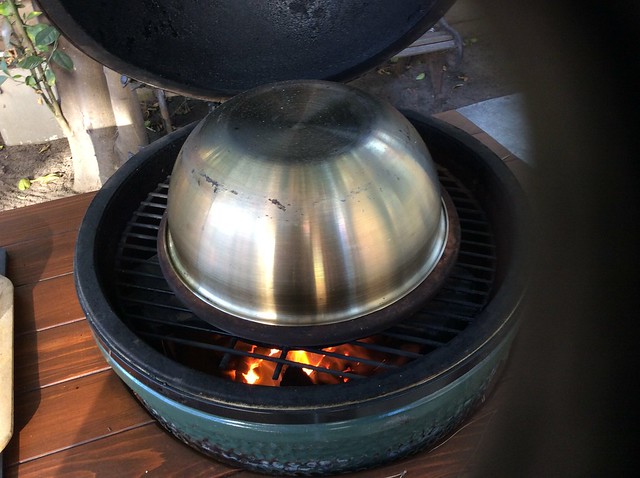
I'm going to show you how to bake sourdough bread in a ceramic oven with a pizza stone and a stainless steel mixing bowl over the top of it to trap the steam. You can use this same method/processes in your kitchen oven also. The techniques/methods are exactly the same.
First thing I do is light the lump coal. Then I install the plate setter legs down. I put the regular grate on top of the plate setter so there is a slight distance between the plate setter and the pizza stone. Then I put a stainless steel mixing bowl on top of the pizza stone. While the pizza stone and mixing bowl are preheating to 500° I set up the necessary tools to execute the cook.
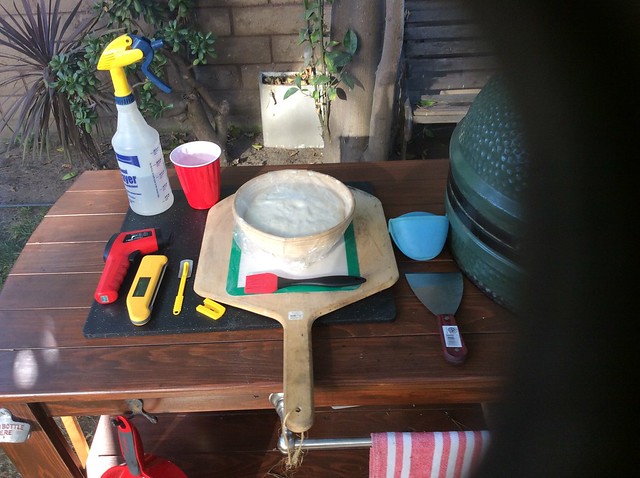
On my wood bench I have a heavy plastic work surface so I don't scratch the wood surface of my BGE stand. I place the following items on or near the work surface.
1. A silicon baking sheet. I use that instead of parchment paper.
2. A pizza peel. To transfer the dough onto the pizza stone.
3. A bread Lame. A razor blade to score the bread.
4. An IF thermometer. To tell when the pizza stone has preheated to 500°.
5. A Thermapen. To make sure the interior of the bread reaches 203/205°.
6. A silicon glove. To remove the preheated stainless steel bowl that's 500°.
7. A bench scraper. To help lift the the hot stainless steel bowl.
8. A spray bottle. To mist the surface of the dough before putting it on the pizza stone.
That water will be trapped under the SS mixing bowl and it will allow the bread to
rise and the ears to open. Steam is important for sourdough bread.
9. An elevated cooling rack. To cool the bread down before slicing it. (Pictured below)
10. A silicon brush. To brush off the excess flour from the banneton.
11. My premixed dough in the banneton covered with a clear plastic shower cap.
12. A plastic cup of water. To dip my lame in before I score the bread.
When my pizza stone is preheated to 500° I dump the dough out of the banneton onto the silicon sheet and brush the excess flour off of the surface of the dough. Then I use my lame to score the dough. Then I spray the dough with water. I use the silicon glove and the bench scraper to remove the stainless steel bowl. I transfer the dough onto the pizza stone with the pizza peel and then put the stainless steel mixing bowl over the top of it.
The mixing bowl traps the steam inside the bowl until you remove it. That steam keeps the skin of your dough soft and pliable during the first part of the cook allow maximum oven spring... Which allows your scoring pattern to open up widely. On this loaf I made a hashtag cut. It raised nicely.
I leave the bowl on for the first 20 minutes of the cook. After I remove the bowl I close the lid and let the crust brown. I remove the daisy wheel and look through the top vent to see how it is browning. Usually the back wall of a ceramic oven cooks a little hotter than the front, up by the bottom vent. I rotate the bread about every 5 minutes during the browning process to get an even color.
I check the crumb temp at about 35 minutes to see where the interior temp is. When it reaches 203/205° I pull it.
This is today's loaf using those methods and techniques...
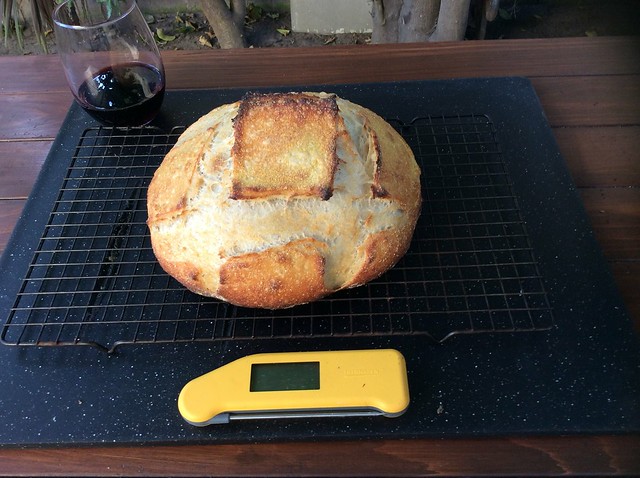
This loaf was:
500 grams bread flour
200 grams sourdough starter
300 grams water
12 grams salt
I mixed this dough by hand in a plastic bucket during the entire process. I started it this morning at 10:00am and pulled it off of the BGE at 4:00pm.
The Dutch oven method restricts your scoring pattern because of your hands being so close to 500° cast iron. Try this and you can get very creative with how your bread looks.😎Last edited by Breadhead; October 29, 2015, 08:32 PM.Comment
-
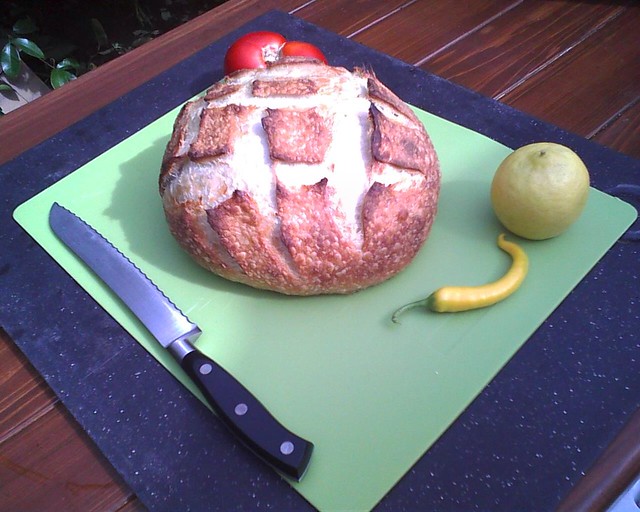
Here is another loaf I did a while ago using these methods and techniques...
Comment
-
Of course, when you promise to others, disaster strikes. Forgot to back down to 450 degrees for the second stint in the oven. Burning resulted. SOB!Comment


Comment