


DaveD It was NY strip
-
-
I hopped on the reverse sear wagon for quite some time, but now I’m back to mostly front sear. It’s just so much easier to cook it to the perfect temp. Plus, like Mosca, I just find it easier to get other things ready while they finish. The process is faster where I can cook a thick steak in around 20 minutes, versus an hour and 20 minutes for reverse sear. I usually get almost edge to edge color by flipping often on the sear (usually 90 seconds a side, 3 flips and rotates on the gasser), then toss on the indirect side. Go inside get other things ready and wait for my combustion to beep.
When I reverse sear I sometimes overshoot a bit getting the sear I wanted or settle for less sear to not overshoot. When I nailed it, it was a better steak though with the addition of a little smoke. Just not worth the extra time and effort most days to me. A good cut, cooked perfectly, and usually a pat of homemade compound butter still beats anything I’m gonna get outside of a Prime A La Carte steak house.
Prime Rib roast, a strip roast, tenderloin roast, that will get reverse seared still.Comment
-
Wait, let me get this straight. To do a sear requires a hot cook zone.
Front sear means you've got your SnS or whatever you're using, ripping hot. Once you've achieved your desired sear what do you do with that heat?
Reverse sear, to me, seems more logical. Start your fire low n slow. As your indirect meat approaches your desired internal temperature, pop the top to let the fire get going hot and when ready sear, flip, sear, flip. Until reaching desired finish temp.
Yes, I'll admit there are times when I'll reach that temp before getting desired sear, but I'll take that over overcooked meat.Comment
-
Sure, the hot zone is in the SnS insert, the indirect zone on the other side. SnS kettles are designed to operate this way. I guess I don't understand the question? Not like I am covering the entire fuel grate with raging coals, only the one side... For this experiment, I won't have the hot side totally full like I do in the below pic, maybe a little more than half - plenty to get a good sear, not so much that the indirect side gets too hot. And if the coals have burned down too low by the time I'm ready to sear the second piece (highly unlikely with B&B given all this should take no more than 30-45 min) I can always have a fresh chimney ready to fire up if need be.Originally posted by HawkerXP View Post
Like so:
Last edited by DaveD; May 2, 2024, 08:25 PM.Comment
-
I await your results with anticipation.Comment
-
Alrighty, today's the day. Writing down my game plan here to collect thoughts and give time for kibbitzing during the day
Here's the pair of strips salted last evening. They're about 14oz/400g each, roughly 1.5in/4cm thick, but not perfectly uniform because I cut them by hand from a Creekstone Prime striploin, not with a machine. I'll probably trim that "nose" of fat off the one on the right before Go Time.
From my records on reverse-seared strips I've done before, I'm anticipating about one hour total cooking time. I'll set up the SnS with B&B coals and a hunk of hickory, and once stable at ~250/120, I'll put them on, one on the indirect side (with temp probe pre-inserted) and one over the coals. After a few minutes of searing until I get a nice crust, I'll move that piece over to the indirect side as well and get a temp probe in it.
Then I'll have to watch temps closely and basically hope that both pieces finish at close to the same time...! Once IT on the rev-sear piece reaches the low 120s/50ish, I'll move it onto the hot side and flippity flip until it's got a good sear. I'm going to try to leave the probe in it so that I don't overshoot like I did last time!
If all goes well, they'll both be at 130-132/54-55 and off they will come and onto the plate with sides of corn on the cob and some broccoli, both of which I can cook hands-free (in the microwave no less, comes out great).
That's my story and I'm stickin' to it!
Comment
-
Alrighty, time for the deliverables and outbrief. Bottom line up front: both the front and reverse seared steaks were just superb. But we both preferred the front seared to the reverse seared, to my surprise. Read on - but I'm going to have to split this into two posts because I can put only 12 photos in any single post and I got more than that
First off, as mentioned before, these were hand-cut from the striploin, not by machine, and one of the steaks was not the same thickness throughout. Both were the same on one end, but one had a taper on the other.
So I decided that the uniform-thickness steak would be the reverse sear, and the tapered one would be the front sear. My reasoning was that I didn't want to risk that thinner section getting overdone during the sear after being on the indirect side.
I put about half a teaspoon of EVOO on each steak and rubbed it in to give something for the granulated garlic and coarse black pepper to stick to (following what Meathead and his cooking partner did in the vid that Mosca posted above). Put a probe in the RS piece, with the plan to add one to the FS piece once I moved it to the indirect side.
Got the kettle going with about 2/3 a chimney of B&B, and couldn't get the kettle any lower than about 300-325/150-165. It'll have to do. Added a small chunk of hickory, and put the FS piece on the hot side and the RS piece on the indirect side, then flippity flippity for the FS piece.
Then moved the FS piece over to the indirect side and inserted a probe.
When I did that, the temp of the FS piece was already about 115/46. It took only about five minutes before it was up over 120/50, so I took it off the kettle and set it aside so it wouldn't overcook while the RS piece progressed. Damn good thing I did that.
Flipped the RS piece when it hit about 100/38.
When the RS piece was ready to sear, with IT just over 120/50ish, I put the FS piece back on the indirect side, since it had cooled to about 115/46. Flippity flippity for the RS piece on the hot side.
All this was happening with the lid off, and the FS piece wasn't warming up on the indirect side. So once the RS piece got to the low 130s/55ish, I switched places and put the FS piece back over the coals to get it back up to target.
Continued in part 2...
Comment
-
At this point, here was my theme music:

I was running back and forth, flipping steaks, getting the sides in the microwave (corn on the cob and broccoli) and thankfully my lovely bride stepped up and got those to the finish line once I started them. I mean literally running, yo.
Got the steaks to where they needed to be finally (all of this took under 30 min), got them inside and got plating. Front sear piece on the right, reverse on the left.
Sliced: FS piece in front, RS piece behind. Both were pretty much perfectly done, and both had noticeable, adorable little smoke rings. Already you can see that the FS piece had a more pronounced sear crust than did the RS piece.
I cut those halves in half again perpendicular to the first cut to give us both full sampling of each piece. My lovely bride had whipped up a compound of unsalted butter, garlic, and the last of her homegrown rosemary from last season.
(I know, on the compound: "Think ya used enough dynamite, there, Butch?" I used only about half of mine.)
FS piece on the left, RS piece on the right.
FS pieces in front, RS pieces behind.
Both of these steaks were just outstanding. But we both enjoyed the FS pieces more: there was more "char" flavor, and it was just a wee bit more tender than the RS piece. Mind you, had we had only the RS piece with nothing to compare to, we'd have been happy as the proverbial clams. But the FS piece was just... better.
My lovely bride made what I think is a very cogent (yes, I'm biased, but just because I'm biased doesn't mean I'm wrong!) observation about why the sear crust was nicer on the FS piece than on the RS. She reminded me that a dry surface will sear better than a moist one, as we all know, and that by the time the RS piece moves over to the hot side, its surface is generously coated with the juices that evolve from the meat during the indirect cooking. I think she is spot on. Same thing happened in the Meathead video - the FS steak in their run was clearly a better sear than the RS steak.
We also both concluded that the texture in the interior was better on the FS piece than the RS piece. I am not sure what to attribute this to. The temps were the same to within a few degrees, although the RS piece did experience a brief excursion to the high 130s/almost 60, but it was super brief, I yanked that sucker off the kettle tout suite when I noticed the temp starting to rise. Hard to believe that just moments at a higher temp would have a big effect, but it could be. I don't think the fire was appreciably different between the times the FS piece seared an 20-25 min later when the RS piece went onto the hot side - those B&B coals were steady.
There were no leftovers! We scarfed down every last morsel of these steaks. They were absolutely delectable. Now I want to do a comparison between FS and SVQ - from memory, we still enjoy the SVQ more than even the FS in this run, but there's no substitute for side-by-side comparison. I will have to put on the thinking cap to come up with a game plan that minimizes variables and makes it so I am not running with plates spinning on sticks...!
All in all, a highly satisfying experiment. But as always, More Data Are Needed!
Thanks for reading this long-winded report! DaveD out.Last edited by DaveD; May 3, 2024, 07:57 PM.Comment
-
This just goes to show ya. It's about the mouth and what it has to say at the end of the day. We eat with all our senses but the rubber hits the proverbial road in the mouth. I agree with the char flavor being more pronounced on a front sear, I simply enjoy that better. You can achieve that in reverse sear but its trickier.
Awesome side-by-side Dave. We need more of these.
-
-
Well done, Dave, and much appreciated! It’s easier to accurately hit my final temp goal with the front sear, so I’d call it a clear winner. I guess the only caveat might be that you could wipe the juices from the RS steak in the interest of improving the sear, but you might lose some flavor.Comment
-
Front sear? Reverse sear? Whatever. Those steaks were awesome!! Outstanding work Dave. I wish I was there to help you out with eating them!!!Comment
-
Thanks for doing this Dave. It was an interesting read.
I prefer a front sear for several reasons. First, it's easier to not overshoot the pull temp when the steak is cooking at the lower indirect temp. Second, I can get the sear I want without worrying about over cooking the steak, and finally, it's a less stressful cook when I don't have to worry about getting a good sear without overcooking.
SWMBO doesn't eat steak often although she does normally ask for a bite of mine if I don't offer, so I'm normally cooking a single steak. I bought a 13" grate that will fit on top of the Weber chimney and I use that chimney upside down for the sear. As much charcoal as will fit goes into the bottom of the chimney and I light and wait for all the briqs to ash over before searing the steak. I flip every 30 secs and will rest the meat several times during the sear. Once I have my sear, I dump the lit briqs into the SnS, put the steak on the 22" grate and monitor the temp until it reaches 138°. When it's done, I eat it without resting. This works for me, but everyone should do what works for them, and if anyone here offers me a steak, I certainly would not turn it down even if it was reverse seared.
Comment
-
DaveD https://www.seriouseats.com/reverse-seared-steak-recipe
I think this is a great article you may find interesting.Comment
-
I still go back to Dave Parrish's SNS video from several years ago where he demonstrates the cold grate method. When I do reverse sear, I still spin the grate and allow the meat to ramp down between sears. I love the mahogany finish you get, not as much char but a wonderful maillard induced flavor that really appeals to me.
Both methods produce slightly different results that's why I do both. It's sort of a potato-potdato thing.
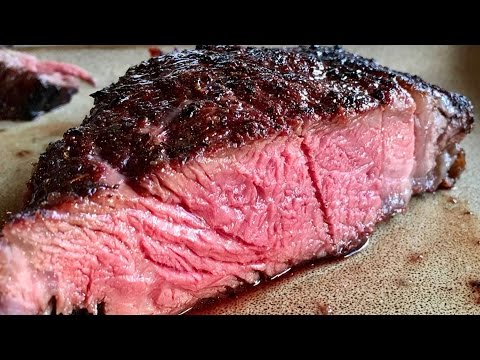
But oh who doesn't enjoy a good old fashioned front sear ribeye???!!! The char from the sear is fantastic. Gives you that real caveman feeling !!!
I'm also going to throw my hat into the ring for the SVQ method, sort of a third option. I suppose this is really a version of the reverse sear method but it's the ultimate in control in giving you that perfect interior with whatever degree of sear finish you desire. As I said above, I go back and forth on how I cook steaks.
At the end of the day, just keep cooking them. Steak is king in my house !!!!


Comment



Comment