





I’ve had my Pit Boss Ultimate, ceramic coated griddle, for roughly 18 months now. I did a favorable review on these pages more than a year ago which seemed to influence a number of fellow members here.
Last night I tuned into Meathead monthly fireside chat where he hooked up with The Flat Top King and talked about most things griddle cooking in general. By the end of the video conference it occurred to me that I hadn’t even cooked on my flat top in about 3 months. With daily temps here in Central Texas running around 105 degrees for most of that time, I had little motivation to stand over a hot griddle for any length of time. The various smokers and grills I did use only required short spurts of attention so were more tolerable. Seasoned griddle users are aware that extended periods of time with no use will often result in unwanted attacks on the cooking surface of a patio griddle. Rust, mold, critter deposits, and other undesirable things are not uncommon. We have a semi feral cat who does a very good job of discouraging pests, and I’m pretty good about cleaning so mold doesn’t invade very often. One of the expected features of the ceramic coating is to prevent rust, and for the most part it did its job.
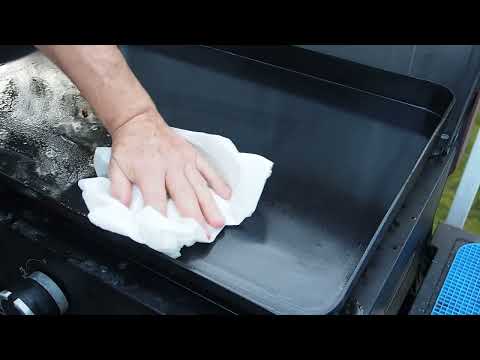
“For the most part” being the operative phrase, I want to discuss what I found and how it’s being resolved. Here is a picture of what I found when the cover was removed, and the lid opened. The main part of the surface looks just fine, it’s just in this one area of a tight 90 degree joint between the large flat cooking surface and the front edge wall. My guess is that as often happens with coating processes, edges and tight corners don’t always get adequate or durable coating. This is usually a process problem caused by poor pre coating preparation, or inadequate material transfer into difficult areas. Whatever the cause, I have a small rust issue to deal with. BTW, this is along the front edge and is likely the result of my not being as thorough as needed in drying the surface after cleaning with water. I probably left a small amount of moisture in that tight edge/corner, and it did what water will do to steel.

Fortunately, this product has a two-year warrantee against defects, so I dug into my paperwork and found my purchase receipt. Just over 18 months to the day since purchased. I called the Pit Boss customer service line, got an answer on the second ring, then had a nice conversation with an articulate young man. He e-mailed me a link to forward a picture of the rust, and stayed on the phone line to ensure that the picture came through at his end. He promptly processed the replacement cook top order and emailed me a copy of the order. Tracking info will follow within a couple business days.
But that’s not the end of my action plan. I’m very happy that Pit Boss willingly agreed to replace the top without any drama. That said, I’m planning to keep that replacement top in stock for potential future use if needed. Having dealt with rusty sheet metal repair in the old car hobby for a few decades, repairing the small amount of rust I’ve got won’t be much of a challenge. Since it’s not in the cooking zone I intend to clean it up and continue to use the top as I have been. I’ll use some Scotchbrite to remove the minimal crusty stuff, then treat with phosphoric acid to convert the rust to an oxide, and then season the area with oil as would be done with a carbon steel pan. Since the repair is not in an area that comes in contact with food or cooking tools it should hold up just as well as a bare steel top that’s been seasoned, and resist rusting likewise. If this ends up being a prelude to continued rusting under the ceramic and the damage spreads into the cook area, I’ll have the new replacement griddle as my fall back.
Am I worried that it would prove to be a continuing problem? No, I’ll have solutions regardless. First the replacement top, and second, I can remove all the ceramic coating and treat it like any other rolled steel top that requires my seasoning it for usage. Either way I’ll continue to have a functioning cooker.
Would I still recommend this product to others? Yes, because it still offers a viable alternative to higher maintenance bare steel tops that are the bulk of the market. Of course it would still be a conditional recommendation……………just as almost any cooker recommendation would be. Some people can’t figure out how to run an offset. I wouldn’t recommend one to them even though I find them relatively easy to run, and feel that I could give useful instruction or suggestions. The same for a barrel smoker, a kettle grill, or a pizza oven. We’ve all met people who seem very able to get in their own way when it comes to learning new skills. Griddles do seem to hold more mystery though. If you go on a resale site, e.g. FB Marketplace, Craigs List, or whatever, you’ll see a significant number of Blackstone griddles with nasty, rusted, cruddy tops for sale. Does that automatically mean that Blackstone griddles (or any other for that matter) are inherently defective? Obviously not.
I will say to my fellow Pit Boss ceramic coated griddle brethren here, keep an eye on your griddle top and be aware of your warrantee period. If you need to get a replacement it’s pretty painless, and if you don’t, griddle on.
Last night I tuned into Meathead monthly fireside chat where he hooked up with The Flat Top King and talked about most things griddle cooking in general. By the end of the video conference it occurred to me that I hadn’t even cooked on my flat top in about 3 months. With daily temps here in Central Texas running around 105 degrees for most of that time, I had little motivation to stand over a hot griddle for any length of time. The various smokers and grills I did use only required short spurts of attention so were more tolerable. Seasoned griddle users are aware that extended periods of time with no use will often result in unwanted attacks on the cooking surface of a patio griddle. Rust, mold, critter deposits, and other undesirable things are not uncommon. We have a semi feral cat who does a very good job of discouraging pests, and I’m pretty good about cleaning so mold doesn’t invade very often. One of the expected features of the ceramic coating is to prevent rust, and for the most part it did its job.
“For the most part” being the operative phrase, I want to discuss what I found and how it’s being resolved. Here is a picture of what I found when the cover was removed, and the lid opened. The main part of the surface looks just fine, it’s just in this one area of a tight 90 degree joint between the large flat cooking surface and the front edge wall. My guess is that as often happens with coating processes, edges and tight corners don’t always get adequate or durable coating. This is usually a process problem caused by poor pre coating preparation, or inadequate material transfer into difficult areas. Whatever the cause, I have a small rust issue to deal with. BTW, this is along the front edge and is likely the result of my not being as thorough as needed in drying the surface after cleaning with water. I probably left a small amount of moisture in that tight edge/corner, and it did what water will do to steel.
Fortunately, this product has a two-year warrantee against defects, so I dug into my paperwork and found my purchase receipt. Just over 18 months to the day since purchased. I called the Pit Boss customer service line, got an answer on the second ring, then had a nice conversation with an articulate young man. He e-mailed me a link to forward a picture of the rust, and stayed on the phone line to ensure that the picture came through at his end. He promptly processed the replacement cook top order and emailed me a copy of the order. Tracking info will follow within a couple business days.
But that’s not the end of my action plan. I’m very happy that Pit Boss willingly agreed to replace the top without any drama. That said, I’m planning to keep that replacement top in stock for potential future use if needed. Having dealt with rusty sheet metal repair in the old car hobby for a few decades, repairing the small amount of rust I’ve got won’t be much of a challenge. Since it’s not in the cooking zone I intend to clean it up and continue to use the top as I have been. I’ll use some Scotchbrite to remove the minimal crusty stuff, then treat with phosphoric acid to convert the rust to an oxide, and then season the area with oil as would be done with a carbon steel pan. Since the repair is not in an area that comes in contact with food or cooking tools it should hold up just as well as a bare steel top that’s been seasoned, and resist rusting likewise. If this ends up being a prelude to continued rusting under the ceramic and the damage spreads into the cook area, I’ll have the new replacement griddle as my fall back.
Am I worried that it would prove to be a continuing problem? No, I’ll have solutions regardless. First the replacement top, and second, I can remove all the ceramic coating and treat it like any other rolled steel top that requires my seasoning it for usage. Either way I’ll continue to have a functioning cooker.
Would I still recommend this product to others? Yes, because it still offers a viable alternative to higher maintenance bare steel tops that are the bulk of the market. Of course it would still be a conditional recommendation……………just as almost any cooker recommendation would be. Some people can’t figure out how to run an offset. I wouldn’t recommend one to them even though I find them relatively easy to run, and feel that I could give useful instruction or suggestions. The same for a barrel smoker, a kettle grill, or a pizza oven. We’ve all met people who seem very able to get in their own way when it comes to learning new skills. Griddles do seem to hold more mystery though. If you go on a resale site, e.g. FB Marketplace, Craigs List, or whatever, you’ll see a significant number of Blackstone griddles with nasty, rusted, cruddy tops for sale. Does that automatically mean that Blackstone griddles (or any other for that matter) are inherently defective? Obviously not.
I will say to my fellow Pit Boss ceramic coated griddle brethren here, keep an eye on your griddle top and be aware of your warrantee period. If you need to get a replacement it’s pretty painless, and if you don’t, griddle on.



Comment