




I always try to put my wood under any charcoal.
-
-
With my SNS Kamado, I always load the firebox with several large chunks of wood, spaced around in varying locations from the center, but NOT dead center. I THEN fill in on top of that with lump charcoal. I then start a single fire starter nestled into the lump in the center. I've never had bad smoke during a cook this way.
For some reason, when using the SNS insert, I always put the wood chunks across the TOP of the charcoal basket, letting them ignite as it burns across the basket. BUT I think the fact that the wood has time to heat up before the fire gets to it reduces any "bad smoke".
And I'll be honest. I think too many people are overly worried about so called "bad smoke". The amount of white smoke generated during a cook as charcoal gradually ignites, using minion, snake, SNS or whatever method, is minimal compared to the amount you see if you light up 5-6 pounds of the stuff all at once in a large chimney.
Before most of my smoking moved to a kettle and later a kamado, I smoked for decades using an offset where I often used 40+ pounds of KBB along with a full bag of wood chunks of mini splits for wood smoke. I would do a minion method with the charcoal in the fire box, and feed the wood mini splits or chunks to the charcoal base as the cook progressed. After the fire burned across the firebox, I would rake coals to one side, and pour in more charcoal to burn back the other way, and add more wood chunks spaced across them. I never got creosote infused ribs or boston butts doing that for many years. And smoke would vary from thin blue to a big of white throughout the cook depending on what I was dropping in the firebox. Airflow was really high though in that cooker, compared to a kettle or kamado.
To me the only truly bad smoke is if it starts getting sooty and black, from choking the fire too much and starving it of oxygen. I've seen that on my old offset, but never on the kettle or kamado.Comment
-
Yes, its very much an individual preference. I know people, one of them a KCBS judge, who prefers the charcoal/smoldering chunk flavor.
I think many others who go from charcoal chunk to pellet smokers, miss that strong smokiness.
And there's others who think meats from a wood burning offset have too light a smoke flavor.Last edited by Lynn Dollar; July 21, 2025, 05:24 PM.
-
-
Well, the wood chunks under the ash basket experiment didn’t work.
I started a few briqs,
Loaded some coal into the basket, placed it on on top, and fired it up,
Got the BGE settled at 250°,
Loaded a couple wood chunks on top of the briqs through the lower vent,
And in about 30 seconds they ignited!
(Right after I snapped this, they started flaming, furiously.)
Which is exactly what I was expecting. And it smelled like burning wood, and smoke started coming out the top vent….
But when I closed the lower vent to hold 250°, the flame went out, and the wood didn’t smolder like I hoped it would. I let it go a good 2 hours before checking on it. At the 2 hour mark I shined a flashlight into the lower vent, and the chunks were lightly charred on top, but otherwise intact.
When I left the lower vent open, they would burst into flames in about a minute; when I reduced the vent opening they went out. I tried leaving the vent open for about 5 minutes, to see if I could get a good enough burn going that it would sustain with the reduced air flow; no. I tried leaving the bottom vent open fully, with just the screen over the opening; with the top vent open just a crack, the temp wanted to hold 400° instead of 250°.
I wouldn’t call the experiment a failure; experiments are never failures, because I got information. But I didn’t prove my hypothesis, which was that the configuration would produce clean blue smoke, without the wood taking up room inside the charcoal basket, and without it burning while the kamado heat sinks.
I’m going to think about this for a while. I still think that I can make something like it work, but I don’t know how yet.Comment
-
I'm not familiar enough with Kamado smokers to add anything here. Before Kosmos Q closed their store here in OKC, I was there talking to them, and they told me to put wood chunks under the charcoal grate on Kamado Joes. But IDK what that really entails.
The small wood splits in my Assassin GF burns combust in flame and stay lit. I add new about every 20 to 30 minutes. Honestly, I can't tell ya how that happens because its as air tight and as insulated as a Kamado.
-
-
I'm a bit perplexed by those that don't see a difference in smoke. Especially here at this site. Meathead and Dr Blonder have made a deep dive into the chemistry of smoke. They've identified the desirable and undesirable chemicals. This is hard science.
But as I've said above, whether the difference in smoke is good tasting or bad tasting, has to come down to individual preference and tastes.
The other explanation is that smoke is just one part of flavor. There's flavor from the meat itself, possibly a marinade, rub, sauce, or whatever flavor layer gets added during the cook. I think that's where the competition cooks are at, i.e. Harry Soo, I wonder if they're concerned about smoke any at all, because they add so many other flavors to produce that " one bite " for the judges.Comment
-
I would say this is false. You get cleaner smoke by placing your smoking wood directly on top of the fire, at the top of your charcoal pile. This goes for any type of smoker or grill.
In my experience and as noted in the article below, you really need way less smoke than you think while you are cooking. As Blonder and MH talk about in their article(s) on smoke, most of the flavor comes in the first few hours of the cook. (What You Need To Know About Wood, Smoke and Combustion.) And it is important to make sure the wood is burning and not smoldering before ignition, or at least you work to limit the time it smolders, especially within the first few hours of the cook.
When I am cooking with my kamados, I will fire up the charcoal basket, then heat sink the BGE and the plate setter. Then I will remove the plate setter and place a 5-6 inch long piece of wood directly on the fire. Then I get nice, clean, blue smoke for the first couple of hours, then she runs clear. That is all the wood I add.
Putting wood down at the bottom of the charcoal pile really does not achieve much smoke when you really need it. Once the meat heats up, there is little smoke flavor transferred to the meat. Once the fire makes it down to that wood, there really is no need to have the wood down there anymore. (Especially in kamados where this can take 10+ hours to get to the bottom of the charcoal basket. It is also important to let the wood burn on the small, hot fire that you get from the lit charcoal. When the wood is placed elsewhere, it can smolder before lighting and burning clean. If this happens when the meat is still cold, it can lead to acrid smoke being transferred to the meat. On the other hand, if it starts to smoke after the surface of the meat is hot, you are not getting much smoke flavor out of it anyway.
Comment
-
Spinaker , well, that's the whole point of putting the wood chunks under the coal bed, is the smoke from smoldering chunks passes through the coal bed and it burns the impurities. That's why GF smokers burn so clean.
I've already gone into that in a post above, about Walter " Stump " McDowell inventing the GF. What I was trying to do with the WSM, was recreate the GF. And I think that's what Harry Soo does. -
BTW, if there's a concern about how soon the chunks will start smoking, just add some lit coals mixed in next to the chunks.
On my Assassin, it takes 30 minutes to get it up to temp, so I put splits in when I light it and there's smoke by the start of the cook. IDK at what point the chunks combust in flame. That could very well be a product of having built up a small coal bed in the ash pan. -
Gotcha. That makes perfect sense. That Assassin is so sweet. You can cook so much food in a relatively small space. I would love to have one to roll up on a trailer for some on-site BBQ cooks! What kind of charcoal do you run in that beast? Lynn Dollar
-
-
Yes, cold and wet meat will take on more smoke and that happens at the start of the cook.
But there's variables.
I wrap when I think the meat has taken on enough smoke, judged by the color of the meat. So later in the cook doesn't matter as much.
But that's not set in stone. On large pieces of meat, i.e. brisket or pork butt, I leave them on the smoker as long as I can keep feeding splits. I will take my brisket to completion on the offset if I don't tire out first.
However, there's this from MH's new book , on page 69 , so each person can draw their own conclusion.
Attached FilesComment
-
-
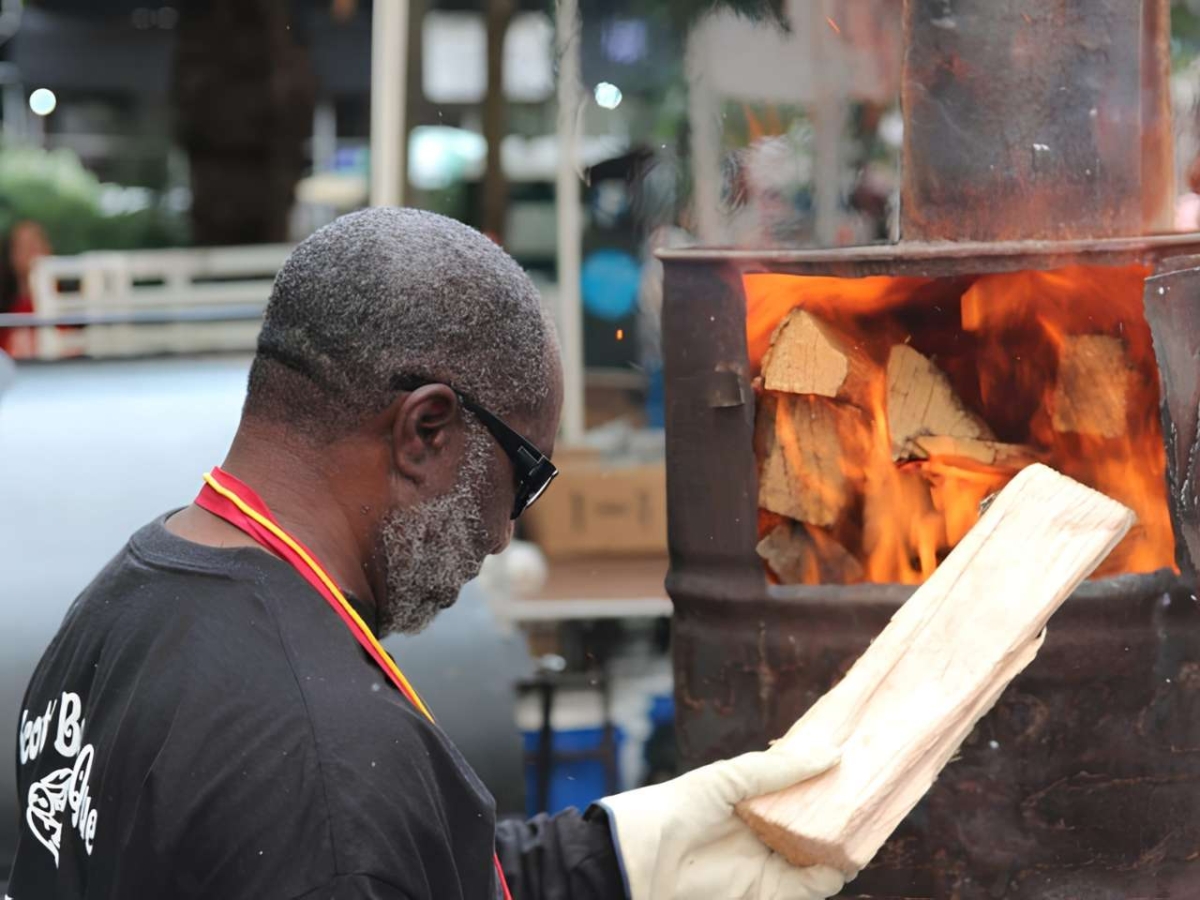
Here is what's happening inside my GF's. I open the firebox door and flames lick out. And its not from a sudden burst of oxygen. And flame from the firebox will extend into the cook chamber. In the Assassin I use slender 8" splits, can see from the pic.
Attached FilesComment
-
-
This has been what we have gone by for years - but in the last couple of years, there is more and of a trend towards dirtier smoke in the early hours of a very long cook - say for briskets or something. I'd say in my limited experience with it, this seems to work fine, that doing a little 'dirtier' smoke at lower temps early in the cook don't hurt things. In fact, some BBQ places are doing this intentionally, look at Bar-A-BQ in Texas, they start a closed-up smoldering fire and let it run overnight on their briskets, and they're definitely getting good result (at least by all reports I've read).Originally posted by Spinaker View Post
It's definitely a complicated process and I think there are many ways to skin a cat. I have gotten oversmoked nasty food on a couple of rare occasions. I ruined a batch of sausage that way once, and I ruined a mac'n'cheese chicken casserole doing heavy smoke on a Weber kettle with too much mesquite chunks. Ugh, that was terrible.
But there is still lots to learn and experiment with.
Matter of fact, I think I want to get a brisket and try out a really smoky low start sometime. Problem is, shit, that $100+ piece of meat I'm risking with experimentation! I don't know that I can do that, especially since I will be pawning it off on others, as my family doesn't really go in for brisket much.Comment
-
Per Harry Soo when I took his class a few years ago, wood chunks on top of charcoal. Not buried in it. Want the wood to burn, not smolder.
FWIW.....Comment
-
I think revisiting this might be helpful
Remember, black smoke, brown smoke, and yellow smoke are bad smoke full of large particles, impurities that scatter lots of light. White smoke is good. It scatters less light because the particles are smaller. "Blue" smoke (practically invisible) is best because the particles are so small they scatter little light. White smoke comes from wood that is SMOLDERING (starved for oxygen). Blue smoke comes from wood that is BURNING vigorously with yellow flames. It is consuming impurities better than smoldering. All this said, putting the wood under MIGHT force the smoke through hot coals and burn off impurities. This is the theory behind the Karubecue, my favorite log burner.
BTW, as you probably know, lump charcoal smokes more than briqs because sometimes it is not thoroughly carbonized. It also snaps crackles and pops.
Burying the wood will probably deprive it of oxygen. I have never tried it. Ditto for wrapping in foil.
Go to a competition and notice that the guys with the big offsets usually leave the firebox door open, maybe not all the way, but they want oxygen.
Remember, charcoal is for heat, wood for flavor. Notice that when you first light charcoal it produces a LOT of white smoke, loaded with impurities. When the coals ash over, not much visible smoke. And I prefer chunks and splits.
Remember, our ability to taste is very poor. When I owned Beverage Testing Institute and ran the American Wine Competition, we often served top tasters two glasses of the same wine from the same bottle among a flite of 6 wines and they often scored them differently. To do a test of wood placement you would have to run two identical cookers side by side with exactly the same charcoal and wood, all variables identical, and a panel of 7 or more tasters.Comment
Comment